
Magic Happens: Chapter 4
Ed's Place

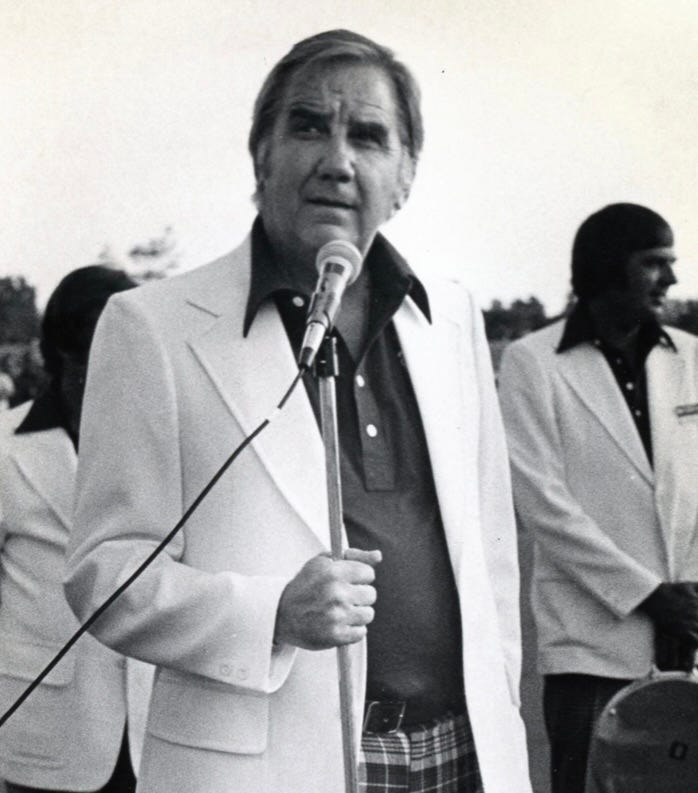
Playing golf really wasn’t Ed McMahon’s idea of a good time, but The Tonight Show emcee never was one to turn down an invitation to a party.
And the chance to host one?
Heyo!
There’s no way of knowing what might have become of the tournament had good fortune and the mysterious Marlin Fuhr not delivered the most famous television sidekick since Ethel Mertz to the Jaycees doorstep in June of 1975. There’s no doubt, though, that the circumstance that allowed the relentless Jerry Adams to get some facetime with McMahon was yet another stroke of early JDC magic.
Sure. Roger Maltbie and D.A. Weibring were strong young players with promising futures when they scored their maiden TOUR wins at Oakwood in 1975 and 1979, respectively. And emerging players like Fuzzy Zoeller, Craig Stadler and Curtis Strange did flash the talent here that would make them multi-time winners and major champions.
Still, the A-list stars of early Oakwood Opens came from the Rolodex of Edward Leo Peter McMahon Jr.
Bob Hope. Jerry Lewis. Mickey Rooney. Telly Savalas. Bobby Riggs. McLean Stevenson. Harvey Korman. Lonesome George Gobel. Bruce Jenner. Evel Knievel. Scatman Carothers. Jack Albertson. Fred MacMurray and his Rock Island native bride, June Haver. Tom Sullivan. Buck Owens. Sammy Kaye.
They came. They golfed. They laughed. They entertained.
They also may have enjoyed a king of beers or two along the way, but the buzz Budweiser’s best pitchman and his friends created in the community undoubtedly carried the still-fledgling golf tournament into the 1980s.
Perhaps it wasn’t the most obvious match, but Ed McMahon and the Quad Cities just worked.
“He cared about the tournament and he gave his all,” said Thom Cornelis, the Hall-of-Fame QC sportscaster who covered the tournament from its inception in 1971 through 2016. “They got more than their bang for the buck with Ed, I’ll tell you that.”
Years beyond his brief involvement, McMahon had fond memories of the tournament and the Quad Cities.
“It’s a wonderful area and the people are nice,” he said in a 1990 interview. “We did have fun.”
Celebrities and the PGA TOUR first became a pairing in 1937 when the Bing Crosby National Pro-Amateur (aka The Crosby Clambake) debuted near San Diego. After taking a hiatus during World War II, the Clambake emigrated up the California coast to the Monterey Peninsula, where it became what it remains today — a four-day co-mingling of serious golf, Hollywood hijinks and the breathtaking coastal scenery that can make the Links at Pebble Beach a wonder of nature or a weatherman’s nightmare.
The Clambake had the celebrity pro-am market covered until 1965, when Hope — perhaps the only Hollywood legend whose passion for golf equaled that of his buddy Bing — became host of an event of his own in the southern California desert. Soon after, Andy Williams was hosting a tourney in San Diego, and then Sammy Davis Jr. put his name on the Greater Hartford Open.
By the time McMahon agreed to host the Quad Cities event, TOUR stops across the country were wearing the names of Danny Thomas, Dean Martin, Jackie Gleason, and Glen Campbell.
In that parade of celebrity hosts, McMahon alone had no passion for the game of golf. He would practice for weeks to hit one shot a year, but never so much as finished a hole in his stint as host.
So why did he agree to host a golf tournament in the Quad Cities?
“I just felt it was a good cause,” McMahon said in that 1990 interview with The Daily Dispatch. “It was a good thing to do and I wanted to give it a try.”
And what compelled the Jaycees to ask?
It started with a haircut.
In December 1974, the aforementioned Fuhr, an entrepreneur from Illinois City, brought McMahon to a QC Christmas party thrown for customers of Fuhr’s International Creations, Inc., which marketed a line of male cosmetics called “Tonight.”
The depth of Fuhr’s relationship with McMahon never was entirely clear. But according to Moline hairstylist Harold Duckett, the Illinois City man did sign McMahon to a personal appearance contract in the spring of 1975.
By then, Duckett’s fellow Moline Jaycees were deep into salvaging the golf tournament, and Duckett was fairly busy himself, charged with chairing the Miss Moline pageant the chapter had sponsored for years.
The pageant became a topic of conversation while Duckett was cutting Fuhr’s hair a month prior, Duckett said, and Fuhr volunteered McMahon’s services as part of their contractual arrangement.
“All the tickets and posters had been printed, but we had a chance to have him come for nothing,” Duckett remembered. “So, we reprinted the program and tickets, doubled the price and sold it out.”
While they had McMahon’s attention, the Jaycees figured, why not press their luck?
“When we picked Ed up at the airport and took him to the Sheraton, we made arrangements for Jerry to ask him if he would do the tournament,” Duckett remembered. “He said ‘I don’t golf.’ And Jerry said, ‘We don’t want you to golf; we just want you to host it.’ He said, ‘I’ll try.’”
And so, it began.
McMahon came alone in 1975 and stayed from Friday afternoon through Sunday. When the TV star declared during the final round that he would return with friends the following July, he effectively stole the headlines from TOUR rookie Maltbie, whose rally from seven shots back at the start of the day is still the JDC record for a come-from-behind win.
McMahon would make amends to his fellow Californian without necessarily trying. In 1978, Maltbie met his wife, the former Donna Davis of Rock Island, while she was working as McMahon’s hostess and assistant at “Ed’s Place,” the temporary bar near the clubhouse entrance where players were invited to stop for a cold Bud.
McMahon, for the record, wasn’t the matchmaker. In fact, the golfer said, “I think Ed was trying to get Donna to date his son.”
The future Mr. and Mrs. Maltbie met instead when Roger walked out of the Oakwood locker room, bound for a dinner party after his opening round. He encountered Donna, whom he’d noticed in his gallery earlier in the day.
“Donna was passing through the clubhouse and, waving, she said, ‘Have a good night, sir,” Roger shared. “I said, ‘sir?’ At the time, I’m all of 27 and she was 22. And so we sat for a minute and I said, ‘Hey, would you join me for dinner tonight?’ Which she did. And without getting into details, we fell in love and we have been together since July of 1978.”
Maltbie — who’d wind up working for NBC himself as a longtime member of the network’s golf broadcast crew — was one of three PGA TOUR players who met their future wives at the Quad Cities tournament.
Victor Regalado met Moline’s Carol Piloponis, a transportation volunteer, three years prior to winning the 1978 QCO. From the winner’s circle, he announced his plans to use the $30,000 check to fund a wedding.
Canadian Dan Halldorson divvied up runner-up money with Regalado and two others as part of an epic five-man, eight-hole sudden-death playoff won by fellow Canuck Dave Barr in 1981. A year later, Halldorson met the former Pat DeBoever. He moved to her nearby hometown of Cambridge, Illinois, when they married. It remained Halldorson’s home until his death in 2015.
Halldorson didn’t make his first QC start until 1981, so he missed out on “Ed’s Place.” Maltbie, however, had more than a few malt beverages there. Regalado may have as well. Stopping for a post-round cold one with the host, after all, was almost as mandatory for the QCO pros as signing a correct scorecard.
“Oh yeah, he had a great time,” Maltbie said of McMahon. “I don’t know how he did it. When they first built ‘Ed’s Place’ it was just a red-and-white-striped tent. Not air-conditioned. And it can get a little hot at your place in the summertime. But he’d sit there in that tent all day and have a beer with every group that came through. He was a terrific host, he really was.”
Jack Pulford — the Jaycee whose Greenbriar restaurant and bar across from Moline’s SouthPark Mall would serve for years as the post-post-round tournament hangout for golfers, caddies, and fans — drew the assignment of assisting the celebrity host in any way he needed assistance. He said “Ed’s Place” was entirely McMahon’s idea.
“After the first year, Ed said, ‘What are the chances we can get a place where we can really host these guys? Can you build a bar?’” Pulford recalled. “We built it right in front of the clubhouse. Neon signs said ‘Ed’s Place.’ We had a ‘Victoria’s Corner’ for the wives. The pros loved it.”
Most did, certainly. Even — or, perhaps, especially — some who later might choose to remember it differently.
“Oh, I was never around on that part of it,” deadpanned 1976 QC runner-up Zoeller, the two-time major champion renowned throughout his career for a sense of fun on and off the fairways. “Ed brought everybody in. Ed was always funny because if he had a hair out of place, (his wife) Victoria was there to brush it back in and put some spray on it. He was a great guy, and it was nice to have his name on the tournament because I think it brought something to the table.”
McMahon certainly brought showbiz glitz to the Quad Cities.
“From being on The Tonight Show for 28 years, I knew everybody in the business,” he recalled in 1990. “I’d ask them either by phone or by letter. And they all had a good time.”
Well, some more than others.
Gary Stanley served a decade on the tournament board as celebrity director. Beyond the McMahon years, he, Pulford, and a handful of others imported celebrities culled largely from the TV program Hee Haw and the Miller Lite commercial stable of comedians and former athletes to continue the pro-am parties. In 1985, Bulls star and golf fanatic Michael Jordan drew the largest galleries since Bob Hope when he played in the pro-am. Given his passion for the game, Jordan gladly would have returned for years to come had his endorsement agreement with a certain golden-arched fast-food chain not conflicted with the title sponsor who came aboard the following year.
In the beginning, though, McGriff’s Air King, with Stanley at the controls, was a chief importer of McMahon’s Hollywood chums. In July of 1976, Stanley had the pleasure of piloting the Ringle Express plane to pick up Jerry Lewis in St. Louis, where the occasionally prickly entertainer had arrived following a long flight from Europe. Upon landing in Moline, Lewis nonetheless made a quick sprint to Short Hills Country Club in East Moline to play a round of golf with McMahon’s manager, Jack Drury. Then he returned to the East Moline course at the crack of dawn on pro-am day to get in another nine.
Lewis got to Oakwood in time to make a promotional ad for his Labor Day Muscular Dystrophy telethon and then headed out for his pro-am round in something less than a good mood.
Six holes into a sweltering afternoon, Lewis left the course when his ulcer flared up. In hopes of calming his stomach, he stopped for a plate of eggs and some cottage cheese in the Oakwood clubhouse before leaving town. But even the meal didn’t go as planned when Lewis dumped his plate of food on the lap of fellow entertainer McLean Stevenson. “Just to try and get a laugh,” remembered Stanley, who was seated between them. “But it wasn’t very funny.”
Stanley had more pleasant memories of the McMahon era, particularly of the show Hope and a cast of several put on at Circa 21 in Rock Island on the eve of the 1977 pro-am, the first of a succession of pre-Pro-Am shows. WHBF-TV set up a camera on a fire escape across the street and did live interviews with the celebrities as they arrived via limousines at 15-minute intervals.
“They timed everything perfectly,” remembered then-WHBF sports anchor Don Sharp, who hosted the interview segments with Stanley and WHBF news anchor Wendy Ellis. “It all built up to Bob Hope being the last one. He and McMahon came together, and we spent 10 or 15 minutes with them.”
A lot of other treasured tournament memories were crammed into those four years the McMahon celebrity pro-ams played through at Oakwood.
In 1976, McMahon joined Cornelis in the studio as he launched the nightly tournament recap programs that remain a staple to this day on WQAD-TV, the Official Television Sponsor of the Tournament since the mid-1980s.
“He didn’t have to come on our show every night, but he wanted to,” Cornelis said. “He had fun with it.”
The fun often lasted beyond tournament week, when McMahon returned to work in Burbank, California.
“Johnny Carson would give him a hard time. ‘So, where’s your tournament? There’s how many cities in the Quad Cities? Five?’” Cornelis said of this numerically incongruous community’s 18 minutes of fame. “Ed got a kick out of trying to explain that. I don’t think he ever did fully understand it. But he enjoyed talking about it.”
Gene Smith, the WQAD sales director and 1983 tourney chair, remembered raucous VIP dinner parties at the Old Oaks in Milan and The Dock in Davenport. Stanley shared drinks with Hope while the entertainer sat in his boxers in his hotel room at the Sheraton in Rock Island. Pulford played liar’s poker with Telly Savalas on a shuttle bus from the pro-am eve dinner back to the hotel. “And I took him for 20 bucks,” he said.
The private parties at the Sheraton were memorable, too. “That was Ed’s forte, and the parties were great,” Pulford said.
But, alas, sooner rather than later, the party was over.
A conflict with a scheduled appearance at the 1980 Moscow Olympics boycotted by the U.S. forced McMahon to miss that year’s QCO, and the entertainer never returned. “I just had to give it up because every time I got somebody to play in my golf tournament, they wanted me to come to theirs,” the entertainer explained a decade later. “Even though I’m not a golfer, they wanted me to come to their shows and such. I had so many markers to pay back when the thing was over, I just couldn’t keep up.”
McMahon repaid his guests with more than a reciprocal appearance at their events, however. He also lavished them with gifts on the QC tournament’s tab. According to Gene Smith, those ranged from sterling silver platters to Daum Crystal shaped like driver heads.
“First-class airfare and hotel expenses. Room service charges,” Smith recalled of bills that would arrive months after the tournament concluded. “Five figures, or high four figures, in hotel expenses for Ed. He always had an entourage of five to 10 people.”
McMahon’s penchant for excess would continue late in life. Prior to his death in 2009, he faced bankruptcy and was forced to rent his own foreclosed-on Beverly Hills mansion from a landlord named Donald Trump.
The bills McMahon left behind in the Quad Cities weren’t entirely responsible for the financial crises the QC tournament would face a few years after his exit. And, besides, whatever the cost for McMahon’s involvement with the tournament, it very well may have been a savvy down payment on a 50-year future.
A decade after the last can of Budweiser was popped at “Ed’s Place,” at least one person felt certain McMahon’s improbable participation helped keep the tournament going.
“I think I gave it a kick in the rear-end, gave it some motion,” said the famed TV sidekick himself as the first $1 million Hardee’s Golf Classic readied to tee off in 1990. “That satisfies me.”
(This content, first published in 2021, is shared with the permission of the Quad City Golf Classic Charitable Foundation. Please consider a donation to Birdies for Charity.)