
Magic Happened: Chapter One
Crow Valley Comes Alive

Caddies have more than carried their weight through the history of the John Deere Classic.
At least a half-dozen Quad Citians spent a year or more as caddies on the PGA TOUR after scoring their first professional bag at the Quad Cities Open. Tony Navarro, in fact, went on from his first loop at Oakwood in 1976 to gain a good measure of fame — not to mention a comfortable living — working alongside Greg Norman during the Great White Shark’s long run as the top-ranked player in the world. Navarro continues to make his home in Moline, and also continues to travel the world as one of the best and most experienced caddies on TOUR.
Another Moliner, Montana Thompson, gave up his professional caddie bib after 17 years but still travels the TOUR as a scorekeeping rules official and occasional sound technician for CBS.
The current JDC tournament director caddied summers at Crow Valley Golf Club and Davenport Country Club from the time he was 13 until his final year at Bettendorf High School. By coupling his caddie coin and high school graduation loot, Clair Peterson joined DCC on a junior membership. He played and practiced often enough his last summer prior to college to claim a 2 handicap, and he put it to good use, too. On a hot September afternoon in 1971, Peterson edged department store scion Dick Von Maur 2-up in a 36-hole club championship match-play final. He changed his shoes in the parking lot, tossed his clubs in his trunk, and drove straight to Iowa State University in Ames to begin his pursuit of a college degree.
Peterson’s predecessor at the tourney helm wasn’t technically a caddie. But before Kym Hougham went to the University of Illinois to play golf on a scholarship in the mid-1970s, he worked in the Crow Valley bag room. Hougham remembers standing for three hours on the putting green one damp, cold evening in September 1972 while a rookie professional already developing a reputation as an ultimate grinder worked relentlessly on his putting stroke. That rookie nearly put all that practice to good use, too. Tom Watson finished as runner-up to defending champ Deane Beman at that second Quad Cities Open and went to become one of the game’s all-time greats.
A good number of the hard-working volunteer chairs who have kept the John Deere Classic on task over the past 50 years also first learned to love the game as caddies. And, notably, Sam Allen — the Deere and Company chair who championed the tournament for more than 20 years — earned an industrial management degree (and played on the Purdue University golf team) as an Evans Scholar.
That Western Golf Association scholarship program has given hard-working young caddies access to higher education for the past 90 years. So, to say the caddie’s broad-shouldered, blue-collar strand of DNA is unique on TOUR to the John Deere Classic might be presumptuous. But it would not be a stretch to say the work ethic caddying fosters is foundational to the JDC’s volunteer workforce and endemic to the makeup of the Quad-Cities as a whole.
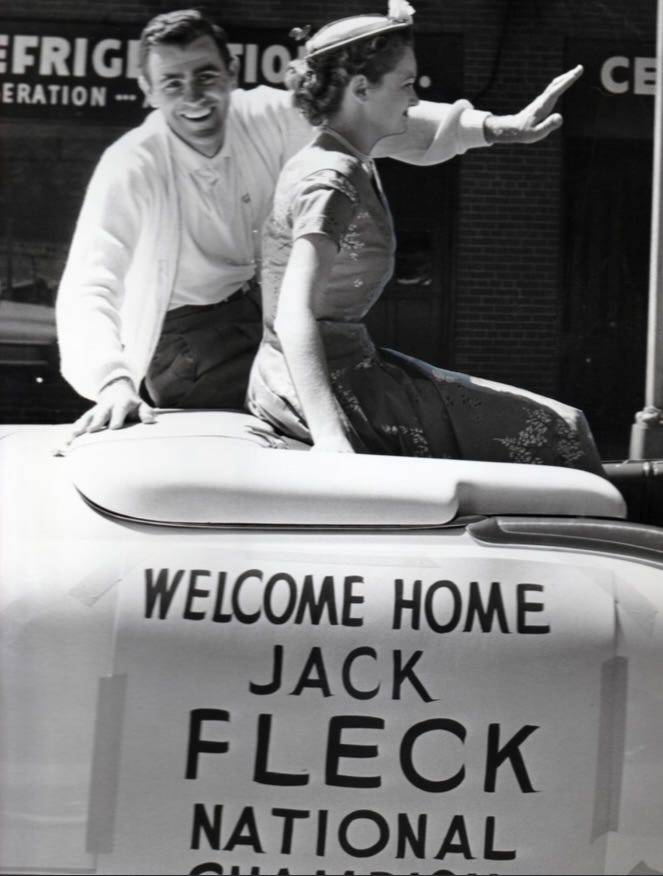
Our most accomplished native golfer, after all, was a child of the Great Depression who honed his self-made swing with a borrowed 7-iron while waiting to pick up bags outside the DCC caddie barn. Until his death in 2014, Jack Fleck insisted the only swing instruction he received in his youth came via this Scottish-tinged admonition from DCC head pro Tom Cunningham: “Caddie, hol’t on to that club!”
Fleck did indeed grip it just a little tighter and, playing out of the pro shops at Duck Creek and Credit Island Golf Courses, won the 1955 United States Open in an 18-hole playoff over the legendary Ben Hogan.
The Quad-Cities golf community still was buzzing over Fleck’s epic upset three years later when yet another future JDC influencer took up caddying to build his college tuition fund.
John Wetzel’s tips at Arsenal Golf Club in the late 1950s and early 1960s averaged about a quarter per trip. But, with a bag on each shoulder and both ears wide open, the future volunteer tourney chair profited in other important ways while trailing community icons like Dr. Paul Barton, Ed Mueller, John Lujack and Franklin “Whitey” Barnard.
“It was fun to caddie for all those guys,” Wetzel recalled. “I learned a lot. I learned a lot about life. I learned a lot about responsibility, and I learned how to deal with people.”
He also learned of promising possibilities for the future of golf in the Quad Cities.
“There was a cadre of members who were thinking professional golf at the time,” Wetzel said. “They were talking about building a golf course that was championship quality, with the idea of trying to get a tournament. That was the talk for four or five hours as I was slinging bags around the course.”
The golf course Mueller, Lujack, Barnard, and other well-connected, golf-minded local businessmen were imagining would, of course, become Crow Valley Golf Club. Yet, the talk was speculative and the idea a long way from fully formed when Bob Fry arrived on the QC golf scene in the fall of 1960.
Hired to replace Fleck’s brother-in-law and successor, Jack ‘Curly’ Wayne, as Davenport’s head professional, Fry arrived just in time to introduce the city’s third municipal course, Emeis Park, in the spring of 1961.
Among the new pro’s earliest and steadiest Emeis customers was Jim Hasley, then a 27-year-old husband and father with a sales job that paid the bills but didn’t offer much in the way of job satisfaction. Fry saw in Hasley a raw amateur golfer with a smooth and easy putting stroke and a temperament to match. The latter was an attribute he was seeking in an assistant pro, and Fry tried three times to convince Hasley to fill that role. Fry’s wife, Sylvia, had to ask only once, with an assurance that Hasley could both support a family and love his work. Given that, Hasley launched a full and fulfilling life as the face — and deep baritone voice — of public golf in the Quad Cities.
It was while working alongside Fry that Hasley heard his boss’ vision for bringing a professional tournament to the Quad-Cities.
“We sat long nights in front of the pro shop at Emeis on the old picnic tables and talked about all this stuff that eventually happened,” Hasley said. “We didn’t know exactly how it was going to happen, but in the back of his mind, he was planning all of this.”
Fry got the new municipal course off to a rousing start by welcoming Gary Player and Arnold Palmer for an exhibition in 1961, and then was a part of an exhibition foursome himself when Palmer returned the following year. With the full backing of the park board chairman who hired him — a fellow named Franklin “Whitey” Barnard — Fry also brought three Iowa Opens to Emeis and even won the middle one in 1967.
“Early on, he thought with some tweaks, Emeis could be a TOUR course,” Hasley said.
Ultimately, that wasn’t going to work, but it didn’t take Fry long to make the kind of friends who could help make his vision of a TOUR-caliber track a reality a few miles to the east. Fry quickly became a staple of Monday matches at Arsenal Golf Club that included Barnard, Mueller, and Lujack. And the conversations that a teenage Wetzel overheard about a championship-caliber golf course a few years before quickly picked up steam.
Where, more than how, was the question of the moment.
The answer eventually emerged near what years later would become the Quad Cities’ most bustling business corridor, an expanse of land at the confluence of I-74, East 53rd Street, and Utica Ridge Road.
While he was growing up in the mid-1960s, Craig Dexter’s family homestead stood surrounded by nothing but corn and cows on the exact spot where Biaggi’s Restaurant stands today. About a mile up the road, the Dexter family owned another 80 acres of farmland, starting at the approximate place you’ll find the ultra-modern Crow Valley clubhouse.
“Very rural,” Dexter remembered of the family acreage and all that surrounded it for as far as the eye could see. “There was nothing developed around there, and even after they started Crow Valley, the development really didn’t catch on except for a few homes. When they built the interchange at 74 and 53rd, that’s when that whole area opened up in the mid-90s. That’s when it really took off.”
The slow growth for the nearly 2,000 acres of land purchased north of 53rd Street and east of Utica Ridge was an unforeseen development for the 34 original investors in what was called Crow Creek Estates, Inc.
The group consisted of a veritable Who’s Who in Quad Cities business circles. The president was Deere executive George French. Vice presidents included James McLaughlin of McLaughlin Body Co., Alan Howard, also a Deere exec, and Mel Foster Jr., whose family owned the largest realty company in the area. Mueller, a lumber yard magnate, was the secretary. Lujack — the former Notre Dame Heisman Trophy winner, Chicago Bears quarterback, and owner of the QC’s largest car dealership — was a director.
A successful travel agent who combined his work with a passion for playing golf around the world, Barnard was among the numerous others described as a founder in a March 1969 Quad-City Times article that announced the project under the headline: Private Golf Course Work Under Way.
A group with the collective business acumen contained within the Crow Creek 34 certainly doesn’t set out not to make a profit. In this rare instance, however, monetary success may have been secondary to the primary mission of building a great modern golf course with watered fairways, challenging greens, and, above all, easy access to the first tee.
“The real impetus for founding the new club was that these guys were all avid golfers and they didn’t like to have tee times,” Bob Van Vooren, one of three surviving founding Crow Creek Estates members, said in 2018. “They wanted to be able to walk up and play. And, to this day, Crow Valley has never had tee times.”
Another surviving founder, construction company owner Wally Priester, built the original Crow Valley clubhouse. He declined to say precisely what he and his fellow original investors paid for that no-tee-times privilege, but he said, “It was far from a money-making thing. In fact, it darned near went broke a couple of times.”
Van Vooren joined the venture along with law partner Larned Waterman. He said profit was definitely a concrete goal for the Crow Creek Estates, Inc., group. But the problem from a development standpoint was that concrete roads arrived more than a decade behind the golf course.
“The land around the golf course didn’t blossom as commercial and residential for quite a while,” he said. “And it took a while longer for the I-74 interchange at 53rd Street to be built by the state of Iowa. And then it took a while for 53rd Street to get paved and for Utica Ridge Road to be paved. Those were bumpy tough roads way back then.
“We all were overly aggressive and overly ambitious,” he added. “But you know, it worked out. It has turned out to be a swell club.”
The wait for the golf course wasn’t a long one once the corporation was formed. A design was completed in short order by little-known architect John N. Cochran of Denver, and dirt was moved even before the land was rezoned from agrarian to commercial. The Wadsworth Company of Chicago was the builder, but, according to Hasley, both they and designer Cochran had considerable help from one eager source.
“The Wadsworth owner said that Bob Fry’s name should be on the bottom of the plans,” Hasley remembered. “What he would do is he would go out with clubs in his hand and hit shots from the dirt in different places. ‘This is the tee. This is the approach.’ He was envisioning the course and redesigning it all along.”
That Fry would be the Crow head pro was a fait accompli long before he turned in his resignation to the City of Davenport in August of 1969. “He knew he was going,” said Hasley, who was named Fry’s replacement within a matter of months. “I didn’t know he was going. But he knew he was going.”
Crow Valley Golf Club opened on May 29, 1970, 15 months after the first spade of dirt had been turned and several months before the $600,000 clubhouse was complete. Membership numbers exceeded expectations, club president Ed Mueller boasted to the Quad-City Times on opening day, with close to 150 founding family members aboard.
About that “family member” description?
“Funniest story,” Priester shared. “When we first started having meetings, the idea was it was going to be a men’s-only club. That idea lasted until we all came home and told our wives. And that was the end of that. I guess we were a lot younger and wilder in those days.”
One other piece of the original plan didn’t materialize. Early plans called for a third nine holes.
The part of the plan discussed while teenage caddie Wetzel was trailing Mueller and friends over the fairways at Arsenal CC certainly would come to pass, however. Before the first member shot was struck on that opening day in May of 1970, Fry, Barnard, and friends were laying the groundwork to bring the PGA TOUR to town.
(This content, first published in 2021, is shared with the permission of the Quad City Golf Classic Charitable Foundation. Please consider a donation to Birdies for Charity.)